
Infrastructure
Hi-Tech Infrastructure
A growing armamentarium of surgical techniques is available for treatment of Benign Prostatic Hyperplasia (BPH). Transurethral Resection of Prostate (TURP) has become the gold standard, on account of its capability to remove obstructing prostatic tissue, with durable clinical efficacy. Hemorrhage and risk of transurethral resection syndrome (TURS) are significant disadvantages, and many patients requiring surgery are elderly and/or have significant comorbidities.
-
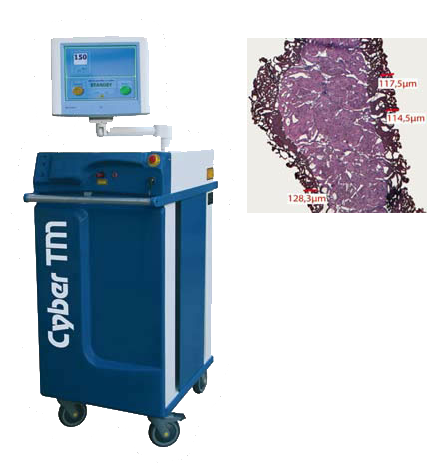
Specifications
- Wave Length : 2010 nm.
- Power : Up to 120 W
- Power Setting : 5 W to 120 W in 1, 5, 10 W Increment Steps
- Treatment Mode : Continuous wave or Pulsed ( 10-1000 ms)
- Beam Delivery : Wide range of Flexible Silica Frontal / End and Side Firing Fibres
- Aiming Beam : 635 nm ( Adjustable <4mW)
- Electrical Requirements : 200-240VAC, Single phase, 50/60Hz, 16A
- Cooling Air Cooled
- Noise Level Less than : 58dBA
- Operating Temperature : 10 deg C – 30 deg C
- Storage Temperature : 10 deg C – 40 deg C
- Humidity : 30% - 90%
- Dimensions :(W)550mm x (D)750mm x (H)1100mm Weight :160Kgs
Advantages - Highly Absorbed by Water
- High Speed Cutting and Tissue Ablation with Very Low Penetration Depth ( 0.2 mm ).
- High Haemostasis.
- High Speed Cutting
- Fast Patient Recovery Time
- Minimal Risk of Erectile Disfuntion
Applications - Vaporisation of Prostate
- Vapo-Enucleation of Prostate
- Bladder Tumors
- Bladder Neck Insertion
- ENT
- GYNAECOLOGY
- HAEMORRHOIDS
- DERMATOLOGY
- NEUROSURGERY
- LAPAROSCOPY
- GENERAL SURGERY
- Side Firing Fibre - 600 µm
- Frontal / Bare Fibre - 600 µm / 400 µm / 200 µm
- 3m Long Sterile & Re-Usable
- Surgeries
- ESWL
EXTRACORPOREAL SHOCKWAVE LITHOTRIPSY Credit for the invention of LITHOTRIPSY goes to Doenier.It is a procedure wherein NO Anaesthasia is required and it is not at all an operation. The Urologist does not even touch the patient.
The patient just lies down on the Lithroscopy table, a 6 inches baloon touches the Lion and Soundwaves hit the body which feels like strong tapping on the skin. It is done on the OPD basis and the patient is called back for subsequent sittings depending upon the size and the hardness of the stone.
1. Success rate 95%
2. No admission
3. Non Invasive
4. No Anaesthesia
5. Age no bar
6. Minimal side effects - PCNL
PERCUTANEOUS NEPHROLITHOLITHOTOMY.
A small 7 to 8 mm puncture is done in the Lion under anaesthesia , endoscope is introduced through this hole into kidney, the stone is fragmented and the fragments are removed through the same hole.
1. Minimal Access Surgery
2. Stones of almost any size cleared
3. Hardness not a criteria
4. Minimal complication
5. Regional Anesthesia
6. Short hospital stay of 2 – 3 days
7. Minimal post op pain - Ureteric Stones
Procedure– A small 2 to 3 mm diameter long slender endoscope is introduced through the urethra into the ureter and the stone is fragmented or removed.
80% stones can be cleared with good success rate.
1.Limitation due to Anotomical constraints, stones migrating up.
2. Miniature or flexible URS may be required
3. C-Arm guidance. - Middle Third Stones
1. Graveyard of radiologist
2. URS 1st choice
3.ESWL
4.Open - Lower third stones
1. Success rate of the URS 98%.
2. Admission less then a day.
3. No pain .
4. Intact stone can be removed.
5. Lithoclast or Laser for larger stones.
6. DJ stent may be required.
7. Meatotomy for UV junction stones. - Bladder stones
1. Almost any stone can be done Endoscopically.
2. Hospital stay less than a day.
3.No pain.
4.Small stones done on OPD basis under LOCAL NAESTHESIA A.Mauer Mayer stone punch.
5.Bladder stone sheath / Nephroscope.
6.Success rate almost 100%
7.Complication rate almost 0% - Antegrade PCNL
1. Large / Hard stones
2. Stones not accessible to URS.
3. Stone migration during URS.
4. Success rate very high
5. Push Bang ESWL
6. Ureterolithotomy, Retroperitoneo scopy, Laparo scopy etc.